
Fibonacci Art – Harmony, Clarity, Lightness, Reduction
Fibonacci art deals with abstract, mostly geometric objects whose dimensions are Fibonacci numbers. This results in works in which the interplay of the individual objects creates simplicity and inherent harmony. This stems from the fact that Fibonacci numbers are closely related to the golden ratio, which describes a ratio of lengths that is very often perceived as aesthetic. Fibonacci numbers fascinate me because they represent a bridge between mathematics and nature, where they occur frequently.
The Fibonacci sequence grows exponentially and extends to infinity. There is no last Fibonacci number. And so every Fibonacci artwork can be mentally continued into infinity.
People find it difficult to imagine the two concepts of infinity and exponential growth.
Exponential Growth
The unimaginability of exponential growth is best illustrated by the old fairy tale of the chessboard and rice.
The old dervish, who defeats the king at chess, asks him for a reward of some grains of rice on each of the 64 squares of the chessboard: one grain on the first square, two on the second, four on the third, eight on the fourth, and so on until the 64th square. The number of grains of rice doubles with each subsequent square. The king, like most people, thinks to himself: ‘Nothing could be easier.’
However, his accountant soon informs him that the number of grains of rice owed exceeds 18 trillion. A trillion is a 1 followed by 18 zeros. Its weight is just under 1 billion tonnes, which is about 1360 times the annual world harvest and the amount of all filled shipping containers lined up end to end would reach from the Earth to the Sun.
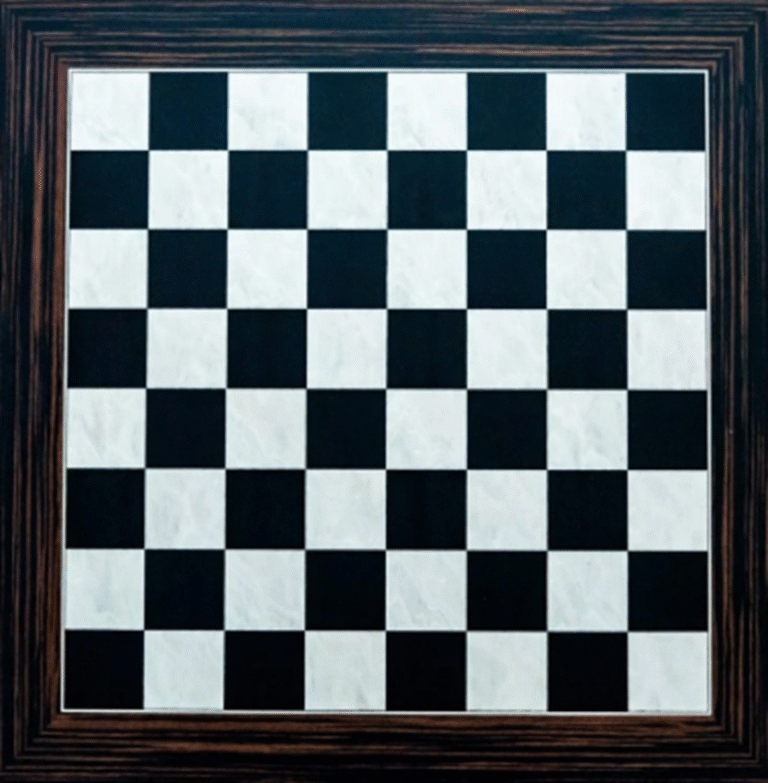
Chessboard, photo: © Copyright 2025, Gauthier Cerf.
Infinity
People also find it difficult to imagine infinity, both in space and time and in abstract things such as mathematics. This is because people are surrounded by finiteness in their everyday lives. Only time and space seem infinite to them.
According to some religions, there is infinite time. It is usually called eternity. Eternity has no beginning and no end. God and humans are immortal and imperishable in eternity. Plato spoke of boundless time, whose beginning and end are inconceivable. Infinite time is thus similar to the straight line in Euclidean geometry: it is a straight line, unlimited in both directions, infinitely long and infinitely thin.
A special case of eternity is timelessness. While eternity does not mean immutability, timeless things are unchangeable and static over time. Time cannot affect them. In electrodynamics, a branch of physics, the photon (the particle of light) is considered timeless. It moves in a vacuum at the speed of light, has no rest mass and therefore does not age. Physical laws, logic and mathematics are also considered timeless and universally valid.
For us humans, space is as much a mystery as time. According to Star Trek, space is infinitely vast. The opposite, a finite universe, is just as inconceivable to us (where would the boundary be?) as infinity. Even the most common cosmological models do little to change this.
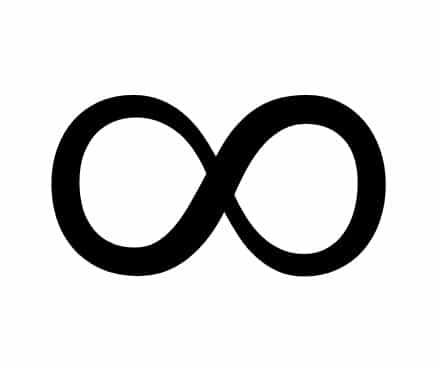
Mathematicians have brought more clarity to infinity. They have also defined a symbol for infinity: ∞
They even distinguish between several degrees of infinity. However, statements by mathematicians about infinity often sound paradoxical. For example, the mathematician David Hilbert showed that a hotel with an infinite number of rooms, all of which are already occupied, can still accommodate an infinite number of new guests. In doing so, he also demonstrated the following inconceivable, paradoxical formula:

© Copyright 2025, Gauthier Cerf. All rights reserved.