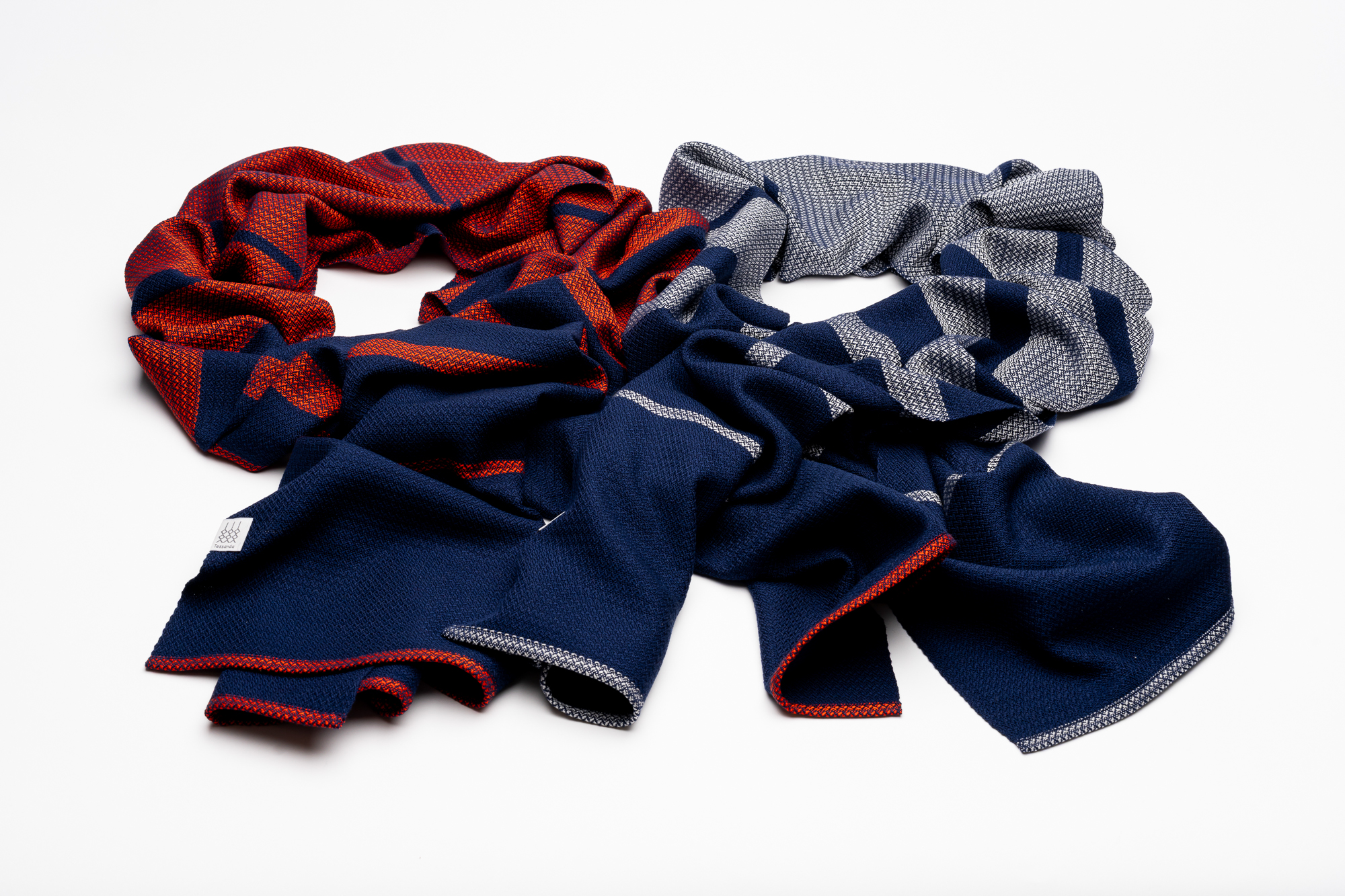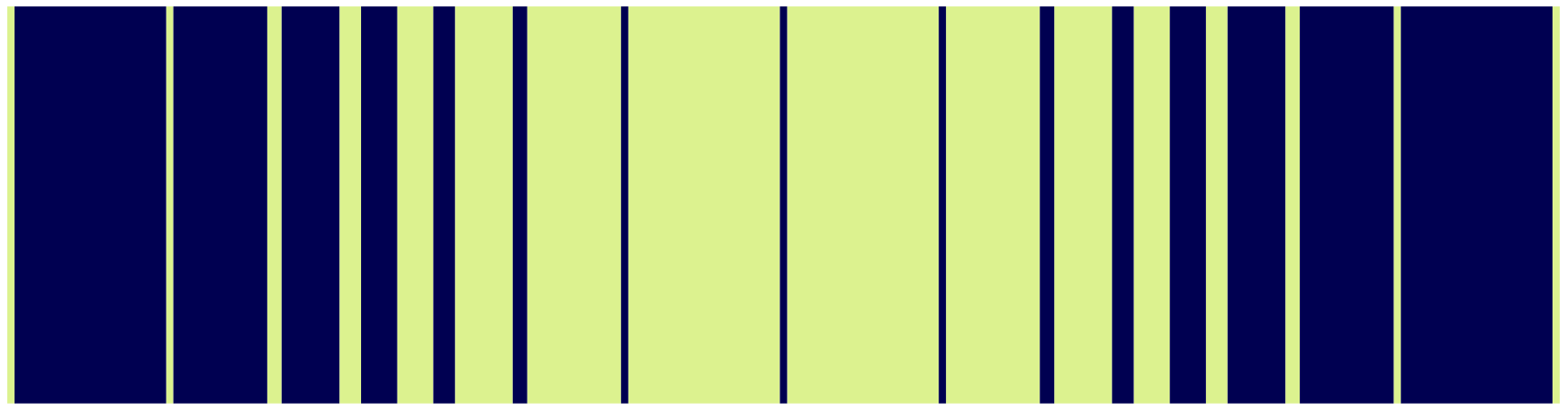
Fibonacci Scarf, Navy-blue-Lime, Gauthier Cerf, FineArt Print, 2025, 34 x 133 cm
The collaboration between Gauthier Cerf and Tessanda
In December 2024, I met Maya Repele, the managing director of Tessanda Hand-Weberei in Val Müstair, at an art exhibition where I was presenting my paintings and sculptures. The idea of collaborating came about spontaneously.
My grandfather worked in a weaving mill for over fifty years, so I have an affinity for weaving and textiles. I was fascinated by the challenge of transferring my visual art to the art of weaving. Soon I was able to witness how the fabrics are developed and handmade in the factory.
An extensive visit to the famous Textile Museum in Tilburg, Netherlands, gave me further inspiration and insights, especially with regard to the connection between art and the craft of weaving. I became aware of what is possible and what is not, how the weave influences the patterns and colours on both the back and front of the fabric. I began to recognise many more details.
I began to design the first drafts for a scarf. The image Fibonacci Scarf (see above) served as the basic pattern. The designs were validated several times by the project team with weavers Luisa and Martina. Weaving patterns were developed in several work cycles and then tested for feasibility on the loom, with continuous refinement where possible. Choosing the thread colours, the appropriate weave and the resulting scarf colours was a challenge. The young weaver Maria patiently counted the threads and adjusted the thread density until the weaving pattern and design matched. It is not easy to achieve the right dimensions when weaving. Among other things, thread thickness, thread density and shrinkage percentages must be taken into account and determined depending on the colour. It was very impressive for me to see how the Tessanda women’s team puts their heart and soul into their work.
The Tessanda women’s team and I agree: it was a wonderful, fascinating and fruitful collaboration! The motto was: Create together. Learn from each other. Inspire each other.
Click here for a short film (Vimeo) by photographer Mayk Wendt, which shows some impressions of the creation process.
I would like to express my sincere thanks to the entire Tessanda team and to Mayk Wendt!
The Design
The scarf is mirror-symmetrical in the centre. From there, one Fibonacci series in a dark navy blue runs to the left and one to the right. The other two series are coloured lime green. They run from the outside (right and left) to the inside and meet in the middle. The lime green stripes form the spaces between the navy blue stripes and vice versa.
The scarf is available in four colours: lime green, silver, light blue (ciel) and orange (poppy). The dark navy blue is common to all.

Accuracy is required.
The Silk Scarf

A selection of yarns for the Fibonacci scarf.
The yarn is high-quality silk, which gives the scarf an elegant sheen and makes it a pleasure to touch. The weave pattern is a twill weave. This causes the two colours to ‘flow’ into each other. Two weft linen weaves are inserted into the weave pattern with its delicate, wave-like marks, which must be woven with a much stronger beat. The click-clack of the loom can therefore be heard at two different speeds and volumes – a rarity.
The Fibonacci scarf is called ‘Luisa’ because Luisa, the weaver, helped develop it. The scarf itself has a paper label attached with the name of the weaver who wove the fabric. A lovely sign of appreciation.

Click here to visit the Tessanda Web-Shop.
And click below to go directly to the scarves: